Cardiology

Cardiology

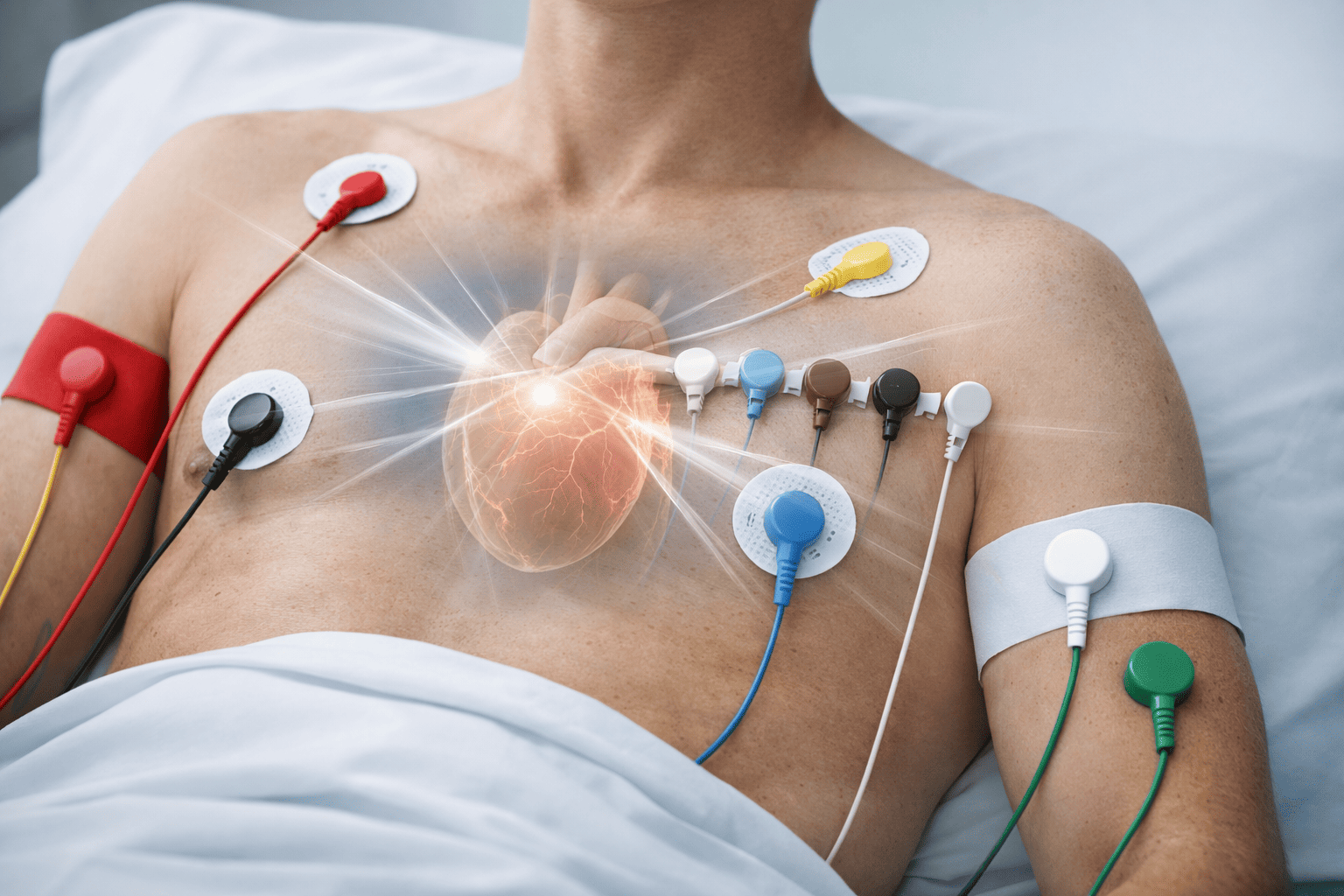
Cardiology is the discipline where physiology becomes rhythm, pressure becomes poetry, and electrical impulses decide life itself. At Medical Wizardry, our Cardiology category is designed for healthcare professionals, postgraduate trainees, practicing physicians, and specialists who seek not just information—but clarity.


The ECG Paper and Calibration: Time, Voltage, and Speed Explained

The ECG Paper and Calibration: Time, Voltage, and Speed Because every interpretation begins with a square. Because every interpretation begins with a square. Before arrhythmias. Before axis. Before ischemia. There is paper. Every electrocardiogram interpretation rests on a deceptively simple grid that encodes time, voltage, and speed. Miss this foundation, and the electrocardiogram becomes a […]

Read More
A Stepwise ECG Reading Method for Beginners:The Only Checklist You Need

A Stepwise ECG Reading Method for Beginners The only checklist you need: a disciplined, repeatable sequence that works in exams, wards, and real patients—especially when your brain is tired. Every medical student remembers this moment. You unfold an electrocardiogram strip and someone asks, “So… what do you think?” Your eyes jump to rhythm, then the […]

Read More
Cardiac Electrical Anatomy Explained: SA Node to Purkinje Mapped to the ECG

Cardiac Electrical Anatomy: SA Node to Purkinje (Mapped to the ECG) How invisible electrical highways create every line you read — and why anatomy-in-motion beats memorization every time. Every electrocardiogram is a story of travel. Not blood. Not oxygen. But electricity—moving with hierarchy and timing. Experts do not see waves; they see pathways. A P […]

Read More
Lead Systems Made Simple — Limb Leads, Augmented Leads, and Chest Leads

Lead Systems Made Simple: Limb Leads, Augmented Leads, and Chest Leads A lead is not a wire into the heart—it’s a viewpoint. Different eyes, same heartbeat, different shadows. Every beginner starts ECG interpretation with a quiet misconception. They believe an ECG lead is a wire connected to a part of the heart. It is not. […]

Read More
Axis for Beginners — Quick Recognition Without Trigonometry

Axis for Beginners: Quick Recognition Without Trigonometry Axis is not math. Axis is direction—and direction is something you can read in seconds using two leads, not two semesters of geometry. In ECG classrooms, the word “axis” has an odd effect: eyes narrow, pens pause, and someone quietly asks if sine and cosine are about to […]

Read More
P Wave Mastery — Normal Atrial Activation and Atrial Enlargement Patterns

P Wave Mastery: Normal Atrial Activation and Atrial Enlargement Patterns The smallest wave on the ECG is often the most ignored. And yet, it whispers the earliest truths. In most ECG readings, the eye rushes forward—to the drama of the QRS, to the tension of the ST segment, to the verdict delivered by the T […]

Read More
ECG Fundamentals — What an Electrocardiogram Actually Measures

ECG Fundamentals: What an Electrocardiogram Actually Measures Before you learn to read ECGs, you must unlearn what you think an ECG is—because it measures electricity, not pumping. Walk into any ward, operating room, or intensive care unit and you will see it: the ECG tracing glowing softly, drawing hills and valleys. For many beginners, that […]

Read More
AV Blocks Explained: First Degree, Mobitz Type One, Mobitz Type Two and Complete Heart Block Recognition

🫀 ECG Foundations • Conduction Blocks AV Blocks: First Degree, Mobitz Type One, Mobitz Type Two, Complete Heart Block From a benign delay to a full conduction “divorce” — learn to recognise atrioventricular block patterns fast, understand what they mean physiologically, and know what matters first at the bedside. Some rhythms do not race. They […]

Read More
Atrial Fibrillation and Atrial Flutter Explained: Recognition and First-Line Concepts

Two atrial rhythms — one chaotic, one deceptively organised — both capable of reshaping haemodynamics and rewriting stroke risk. There are rhythms that whisper. There are rhythms that march. And then there are rhythms that scatter. Atrial fibrillation and atrial flutter live in that last category. They may look like “just another tachycardia” on a […]

Read More
Premature Beats — Premature Atrial Complexes vs Premature Ventricular Complexes

🫀 ECG Foundations • Premature Beats When a beat arrives too early, it is rarely “random.” It is physiology stepping forward—sometimes politely, sometimes loudly. There is a moment in every electrocardiogram where the rhythm breaks its promise. A beat arrives too early. Too eager. Too impatient. The cadence stumbles—just for one heartbeat—and then recovers. To […]

Read More
Sinus Rhythms Explained: Normal Sinus, Bradycardia, Tachycardia, and Sinus Arrhythmia

Sinus rhythms look “simple,” but they are the heart’s most honest language—physiology recorded in real time. There are rhythms that frighten you at first glance. And then there are rhythms that seem harmless—almost boring. Sinus rhythms fall into the second category. But that is exactly why they matter. Before you can recognize chaos, you must […]

Read More
QT Interval and Corrected QT: Why Prolongation Is Dangerous

QT Interval and Corrected QT: Why It’s Dangerous When Prolonged ⚡ The QT interval is not just a measurement. It is a warning system. Ignore it—and the heart may not forgive you. On the electrocardiogram, the QT interval looks deceptively simple: a straight line from the beginning of the QRS complex to the end of […]

Read More
T Wave Basics — Normal Variants vs Pathology

T Wave Basics: Normal Variants vs Pathology The T wave looks like an afterthought—until it becomes a warning sign. Learn what’s normal, what’s “normal-ish,” and what is truly dangerous. The ECG is a familiar battlefield: QRS storms through, ST segments draw headlines, and arrhythmias steal the show. Meanwhile, the T wave sits there— soft-edged, quiet, […]

Read More
ST Segment Basics — Injury Current, Elevation, Depression (Beginner Framework)

ST Segment Basics: Injury Current, Elevation, Depression (Beginner Framework) The ST segment is the ECG’s urgency lane. Learn the physiology of injury current, then read elevation and depression without panic. Among all electrocardiogram components, the ST segment has the greatest power to change management instantly: catheterization laboratory activation, thrombolysis, intensive care unit admission, or a […]

Read More
R Wave Progression in Chest Leads — Normal vs Abnormal

R Wave Progression in Chest Leads: Normal vs Abnormal When the ventricles depolarize, the chest leads quietly map the heart’s direction. Learn what “normal” looks like—then recognize when the story bends. Every electrocardiogram has a moment where it reveals orientation—not rhythm, not rate, not ischemia—just orientation. That moment lives in the chest leads, where electricity […]

Read More
QRS Complex Basics: Depolarization, Duration, and Morphology

QRS Complex Basics: Depolarization, Duration, and Morphology The QRS complex is the ECG’s loudest voice—and the one most often misheard. If the electrocardiogram were a conversation, the P wave clears the throat, the QRS complex speaks, and the T wave reflects. Most learners notice only how tall the QRS is—without understanding how it speaks and […]

Read More
PR Interval — What It Represents and When It Matters

PR Interval: What It Represents and When It Matters Some ECG intervals shout. Some whisper. The PR interval does neither. It waits — and when it changes, it is rarely accidental. In everyday ECG reading, attention gravitates toward drama — wide QRS complexes, elevated ST segments, chaotic rhythms. The PR interval sits quietly between the […]

Read More